Manila Massacre: A Painful Reminder of War’s Impact


Manila Massacre: A Painful Reminder of War’s Impact


During World War II, the City of Manila, the capital of the Philippines, was the site of a horrific massacre that claimed the lives of at least 100,000 Filipino civilians. The Manila Massacre, also known as the Rape of Manila, was one of several major war crimes committed by the Imperial Japanese Army during the war. In this article, we will delve deeper into the events that led up to the Manila Massacre, the atrocities committed by Japanese troops, and the aftermath of the massacre.


The Battle of Manila: Prelude to the Massacre

The Battle of Manila was a major battle fought between Allied forces and the Imperial Japanese Army from February 3 to March 3, 1945. The battle was a key part of the campaign to liberate the Philippines from Japanese occupation, and it was one of the most brutal and destructive battles of the Pacific War.

The Japanese army, aware of their impending defeat, resorted to a strategy of destruction. They destroyed bridges, buildings, and other infrastructure, leaving the city in ruins. They also targeted civilians, whom they suspected of collaborating with the enemy. Japanese soldiers committed numerous atrocities, including rape, torture, and murder.


The Manila Massacre: Atrocities Committed by Japanese Troops

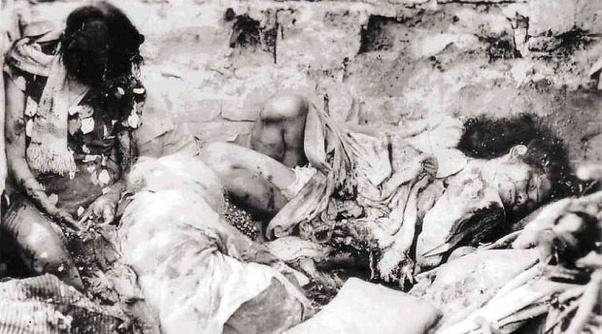
One of the most horrific incidents during the Battle of Manila was the Manila Massacre. The massacre involved the indiscriminate killing of Filipino civilians by Japanese troops. The soldiers used machine guns, bayonets, and other weapons to slaughter men, women, and children. The massacre was so brutal that it was dubbed the “Rape of Manila.”


Legislative Building, Manila, Philippines, WWII damage, 1945.

The Japanese troops did not discriminate between combatants and non-combatants, and civilians were killed in their homes, on the streets, and in hospitals. The massacre was not limited to just one day but occurred over several weeks, from February 9 to March 3, 1945.

The aftermath of the massacre was devastating. Dead bodies littered the streets, and survivors were left to mourn their loved ones and rebuild their shattered lives. The destruction of the city and the loss of life caused by the massacre were felt for years to come.

The Yamashita Trial: Accountability for War Crimes

After the war, the Allied forces held a military tribunal to try Japanese officials for war crimes. Among those held accountable for the Manila Massacre were General Tomoyuki Yamashita and his chief of staff, Akira Mutō. Yamashita, who had been in charge of Japanese forces in the Philippines, was held responsible for the actions of his troops during the battle.

The Yamashita Trial, as it came to be known, was significant because it established the principle of command responsibility. According to this principle, military commanders can be held responsible for the actions of their troops, even if they did not directly order those actions.


12th May 1945: General Tomoyuki Yamashita is fitted with a microphone, prior to his trial for war crimes commencing in Manila.

Yamashita was found guilty of war crimes and sentenced to death. He was executed by hanging on February 23, 1946. Mutō was also found guilty and executed on December 23, 1948. The Yamashita Trial sent a clear message that war crimes would not go unpunished, and it helped establish the foundation for international criminal law.

Remembering the Manila Massacre: Honoring the Victims and Educating Future Generations

The Manila Massacre remains a tragic reminder of the horrors of war and the importance of respecting the rights of civilians during times of conflict. It is important to remember the victims of the massacre and honor their memory. One way to do this is by building memorials and monuments to commemorate the victims of the massacre. In Manila, the Manila Massacre Memorial Wall was built to honor those who died during the massacre. The wall displays the names of the victims and serves as a reminder of the tragedy that occurred in the city.

In addition to building memorials, it is also important to educate future generations about the Manila Massacre and other war crimes. By learning about these events, we can better understand the devastating impact of war on civilians and strive to prevent similar atrocities from occurring in the future.

International organizations, such as the United Nations, also play an important role in educating the public about war crimes and their impact. The International Criminal Court (ICC), for example, investigates and prosecutes individuals who commit war crimes, crimes against humanity, and genocide. By holding individuals accountable for their actions, the ICC serves as a deterrent to future perpetrators.

The Legacy of the Manila Massacre: Impact on the Philippines and the World

The Manila Massacre was a tragic event that claimed the lives of thousands of innocent civilians. The atrocities committed by Japanese troops during the Battle of Manila serve as a reminder of the devastating impact of war on civilians and the importance of respecting their rights.

The Yamashita Trial and other efforts to hold individuals accountable for war crimes have helped establish the foundation for international criminal law. It is important to remember the victims of the Manila Massacre and other war crimes and honor their memory through memorials and education.


We hope that you have enjoyed reading our blog on the world history and facts. If you enjoy this blog please let us know in the comments below. If you are interested in history, we recommend you check out our other blogs here on the world history and facts. Thank you for reading.

Comments

Popular posts from this blog

The capture of brave Russian officer Rosinski

The capture of brave Russian officer Rosinski This is a shocking image and I apologize in advance for sharing it, but here’s one that truly got to me… in Belarus, 1918, after WWI had already ended, the brave Russian officer Rosinski was captured by the Bolsheviks. The Bolsheviks tortured the captain, likely to get information out of the man, which he bravely refused to give. After that, they simply continued with the torture out of some sick sense of innate cruelty. He was ‘the enemy’ and he was at their mercy, so they brutally murdered their captive. The brave captain was emasculated. And anally impaled on a tree branch. All this while still alive. Alfred Savoir, the man who published the picture and was an eye witness to the death of the brave military officer, described "M. B.", who ordered this atrocity, thus: I knew him not long ago; he was a charming teenager with an ironic wit and joker. He was rubbed with French culture, he admired the novels of Barres and he quot...

15 Most Brutal Rape Punishments Around The World.

15 Most Brutal Rape Punishments Around The World. Rape is considered the most offensive crime in every society. Rape victims are often looked down in the society and had to suffer mental torture without any fault of her/him. This horrific impact of physical and mental assault often ruin the life of a victim. Different governments across the globe came up with strong laws against sexual assault to make their country a safer place for their citizen and to make sure no one who indulged in this heinous crime could roam free. Here are the most brutal rape punishments of different countries around the world. In China, The meritocratic leadership punishes the rapist straight away with a death sentence and in some scenarios rapist are also punished by the mutilation of their genitals. 2. Iran In Iran, the rapist is either hanged or shot to death in public. Sometimes the guilty escapes the death penalty by the premission from the victim but is still liable for 100 lashes or life imprisonm...

CLIFFORD HOYT: THE MAN WHO HAS SEEN HELL

CLIFFORD HOYT: THE MAN WHO HAS SEEN HELL I immediately make a premise. Many Paranormal groups report news similar to the one I am about to publish, about a certain Harry Hoyt, aged 31, who died in 1999 a few days after having an accident from which he woke up saying he saw Hell (and they put a scene from the movie “Hellraiser 2” as a photo). Well, what I found in my research is very different, although the common thread is the same. So it's up to you to decide which version is the right one (assuming one of the two is true). Let's go to the facts. The protagonist is Clifford Hoyt (not Harry: Harry Hyot is an American filmmaker to me), 31 who suffered serious injuries in a car accident due to icy asphalt in 1999, on his way home after a long day at work in Maryland. . He remained in a coma for a few hours and when he regained consciousness, he revealed to the nurse that he was looking after him that he had been sucked into a vortex that led him straight to Hell. He told of the p...

After Hiroshima and Nagasaki: Tragedy and Humiliation.

After Hiroshima and Nagasaki: Tragedy and Humiliation.  U.S. and Australian brutalisation of women on the Japanese mainland.   (Excerpt From Pages 66-69) All references are provided in the book itself.  “There was a far darker side to the U.S. and allied occupation of Japan, one which is little mentioned in the vast majority of histories – American or otherwise. When Japan surrendered in August 1945, mass rapes by occupying forces were expected… [despite setting up of a comfort women which recruited or otherwise trafficked desperate women to brothels] such crimes were still common and several of them were extremely brutal and resulted in the deaths of the victims. Political science professor Eiji Takemae wrote regard- ing the conduct of American soldiers occupying Japan: ‘U.S. troops comported themselves like conquerors, especially in the early weeks and months of occupation. Misbehavior ranged from black-marketeering, petty theft, reckless driving and disorderly con...

During World War II, millions of people were sent to concentration camps, including women.

During World War II, millions of people were sent to concentration camps, including women. Women in concentration camps were subjected to brutal treatment and often faced more severe conditions than their male counterparts. The conditions in the camps were inhumane, and women were often subjected to forced labor, starvation, and medical experiments. Women were treated differently in concentration camps than men. They were often separated from their families, forced to perform hard labor, and subjected to sexual abuse. Women who were pregnant were also subjected to harsh conditions and medical experimentation. Many women were killed, either as part of the genocide or because they were deemed too weak to continue working. One of the most notorious concentration camps where women were held was Auschwitz-Birkenau. There, women were subjected to forced labor, starvation, and medical experimentation. Many were killed in gas chambers or through other forms of execution. The camp was designe...

Frank Discussion Of Rape And Other Atrocities Committed During War.

WARNING! PHOTO BELOW ARE NOT MET FOR THE WEAK HEART. Please note: The following subject matter is of immense importance, but could be difficult to read. There is a Frank Discussion Of Rape And Other Atrocities Committed During War. After entering a large museum in one of the world’s most ancient cities and the former capital of the Chinese empire, Nanking—or Nanjing as it’s known today—my 18-year-old daughter Sophia and I walked over a glass walkway that allowed us to look down 10 feet of earth and observe an ancient footpath. Lights highlighted the ground under the glass while the room we were in was dark.  To our right hung numerous photographs on a black wall showing Japanese soldiers slaughtering Chinese citizens in December 1937 revealed by individual lights, the types one sees on art museum paintings. Dead babies, severed heads, piles of bodies on Yangtze River banks, and helpless prisoners of war were all documented there by photographs taken by the perpetrators themselve...

"Wooden Horse or Spanish Donkey"

"Wooden Horse or Spanish Donkey"  The wooden horse, or Spanish donkey, was an extremely painful and gruesome medieval torture device.  It was first used by the Holy Inquisition in France and then in Spain and Germany, and then migrated to the Americas, gaining prominence during the colonial period.  The main design was the same wherever it was used.  It was a triangular wooden box with a very sharp top end (ie where the horse's spine would be).  The apparatus was constructed of wood, with planks nailed together to form a long, tapered ridge, which would serve as the horse's back.  These were supported by four legs attached to a bracket, about 6 or 7 feet (1.8 to 2.1 metres) high, with wheels fitted to the bottom of the legs so that the entire device could roll across the ground.  A head and tail would be attached to make the torture device look like an almost “fun” huge wooden horse.  The defendant would be mounted on the horse, with ankle weights...

The Grabenpanzer

The Grabenpanzer The Grabenpanzer, or Sappenpanzer (trench armor), also called lobster armor, was a German-made steel fist used as personal body armor during the “Great War.” The Grabenpanzer consists of four pieces of articulated steel: a large chest plate and three other plates that cover the user's abdomen and groin. The different plates were connected with canvas straps. Each plate also had a thick felt block inside to silence the sound of steel plates hitting. The armor divided into separate parts allowed the user to be more flexible. The Grabenpanzer weighed between 9 and 11 kg depending on the model and was generally combined with a thick steel front plate for the user’s Stahlhelm (helmet), which added even more weight to the soldier. For this very reason, the Grabenpanzer was not produced for assault troops, but for machine gun teams and soldiers in sentimental service, operating in static positions, where they were highly exposed and unprotected against an enemy rifleman. ...

Masha Bruskina.

Masha Bruskina. Masha Bruskina was a Russian teenage female partisan. She was a 17 year old Jewish high school graduate and was the first teenage girl to be publicly hanged by the Nazis in Belorussia (Belarus), since the German invasion of Soviet Union on the 22nd of June 1941.  Her execution and that of the two men hanged with her took place on the 26th of October 1941 in the city of Minsk. In the photos of her, you will see that she has blond hair, but her natural colour was dark. She dyed her hair when she started to work for the underground. Witnesses to her hanging, testified that Masha struggled hard and lost control of her bladder and bowels.  After hanging for three days, she and the men were taken down and only when her body was traditionally washed before her burial by local people and members of her family, did her dark hair show up. She worked as a nurse in a military hospital and was a member of an underground cell which...

Rubin Stacey, lynched victim, hanging from a tree

Rubin Stacey, lynched victim, hanging from a tree, surrounded by onlookers, including girls, Fort Lauderdale, Florida. Rubin Stacy, 37 was a homeless tenant farmer who knocked on a white woman's door (Marion Jones) – she screamed, and he was arrested.  As he was being led to jail by six deputies, a mob of about 100 overpowered them – ran their car off the road, and lynched him in sight of Marion's house, in Fort Lauderdale, Florida.  Marion claimed she offered him a drink of water, but he tried to assault her with a knife, which she later recanted. A photo of the lynching was sent to President F.D.  Roosevelt to persuade him to support the Costigan-Wagner Act which would bring federal prosecution to any law enforcement officers who failed to exercise their responsibilities during a lynching incident.  - Roosevelt refused to support the bill claiming he would lose Southern votes in the next election.